1.
Heart failure with swollen feet and legs (see figures 37, 38e)
2. Shortness of breath, fatigue
3. Calcification of pericardium (figure 38a, 38b)
4. Possible atrial fibrillation (see figures 14, 15a, 15b, 37)
THE VENOUS PULSE WITH SPECIAL REFERENCE
TO CONSTRICTIVE PERICARDITIS
The normal jugular venous pulse (JVP) reflects
changes in the right atrium
and consists of three positive waves and two negative troughs.
The
positive presystolic "a" wave is produced by the right
atrial (RA)
contraction and is the dominant wave in the JVP, particularly
during
inspiration. During atrial relaxation, the venous pulse descends
from the
summit of the "a" wave. This descent may continue
until a
plateau ("z" point) is reached just prior to RV systole.
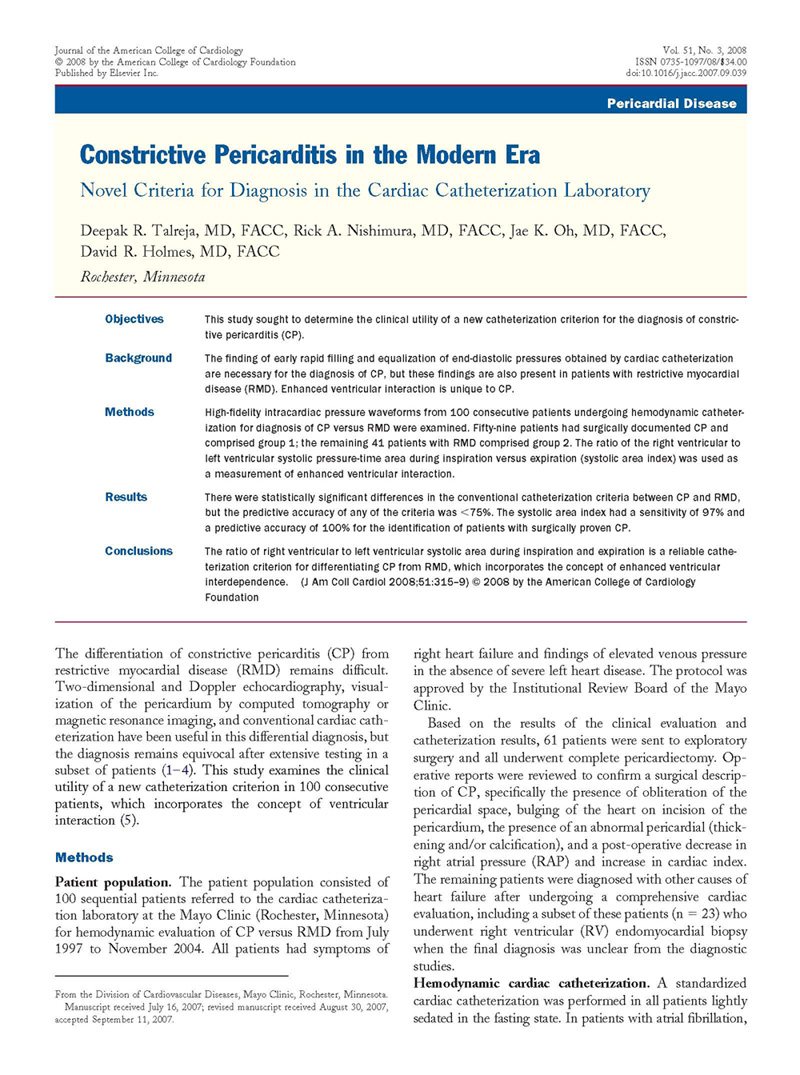
More often,the
descent is interrupted by another positive venous wave , the
"c" wave, that
is produced by bulging of the tricuspid valve into the right
atrium
during RV isovolumic systole and by the impact of the carotid
artery
adjacent to the jugular vein. Following the summit of the "c"
wave, the
JVP contour declines, forming the normal negative systolic wave,
the "x"
wave. The "x"descent is due to the combination of
atrial relaxation, the
downward displacement of the tricuspid valve during RV systole,
and the
ejection of blood from both ventricles.
The positive, later systolic "v" wave in the JVP results
from the
increase in blood volume in the venae cavae and and right atrium
during
ventricular systole when the tricuspid valve is closed. After
the peak
of the "v" wave is reached, the RA pressure decreases
because of the
diminished bulging ot the tricuspid valve opening. In the JVP,
the latter
occurs at the peak of the "v" wave. Following the
summit of the "v"
wave, there is a negative descending limb, referred to as the
"y" descent
or diastolic collapse, which is due to the tricuspid valve opening
and
the rapid inflow of blood into the right ventricle. The initial
"y"
descent corresponds to the RV rapid filling phase. The trough
of the "y"
wave occurs in early diastole and is followed by the ascending
limb of
the "y", which is produced by the continued diastolic
inflow of blood
into the right side of the heart. The velocity of this ascending
pressure
curve depends on the rate of venous return and the distensibility
of the
chambers of the right side of the heart.
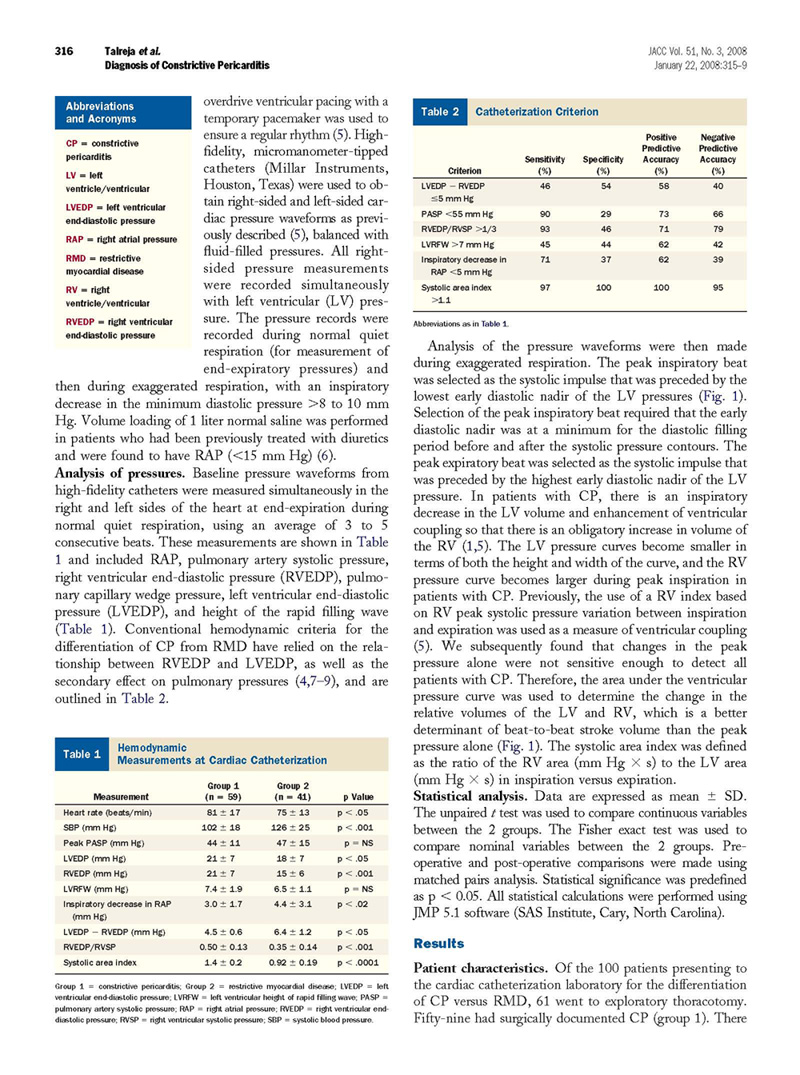
Now the diastolic inflow into the RV from the RA is "super-rapid"
and
"short" (limited to the first 1/3 of diastole), producing
a sharp "y"
descent, a deep "y" trough,and a "rapid"
ascent to baseline in patients
with constrictive pericarditis (fig.
38f). In these patients, cardiac volume is determined by
the thickened, rigid pericardium, and the heart is unable to
exceed this volume, which is attained near the end of the first
third of diastole. During ejection, venous return commences
unimpeded,and therefore, the normal systolic surge of the venous
return is preserved. Cardiac compression remains insignificant
at end systole, so that when the tricuspid valve opens, blood
fills the ventricles at the above referred to supranormal rate.
Thus, in constrictive pericarditis, the venous return is biphasic,
but with a diastolic compoment greater than or equal to the
systolic component.
Rourke,R.A. and others, The History,Physical
Examination,And Cardiac Auscultation ,Hurst's The Heart,10th
edition,pages 226-230.
HEMODYNAMICS OF CONSTRICTIVE PERICARDITIS
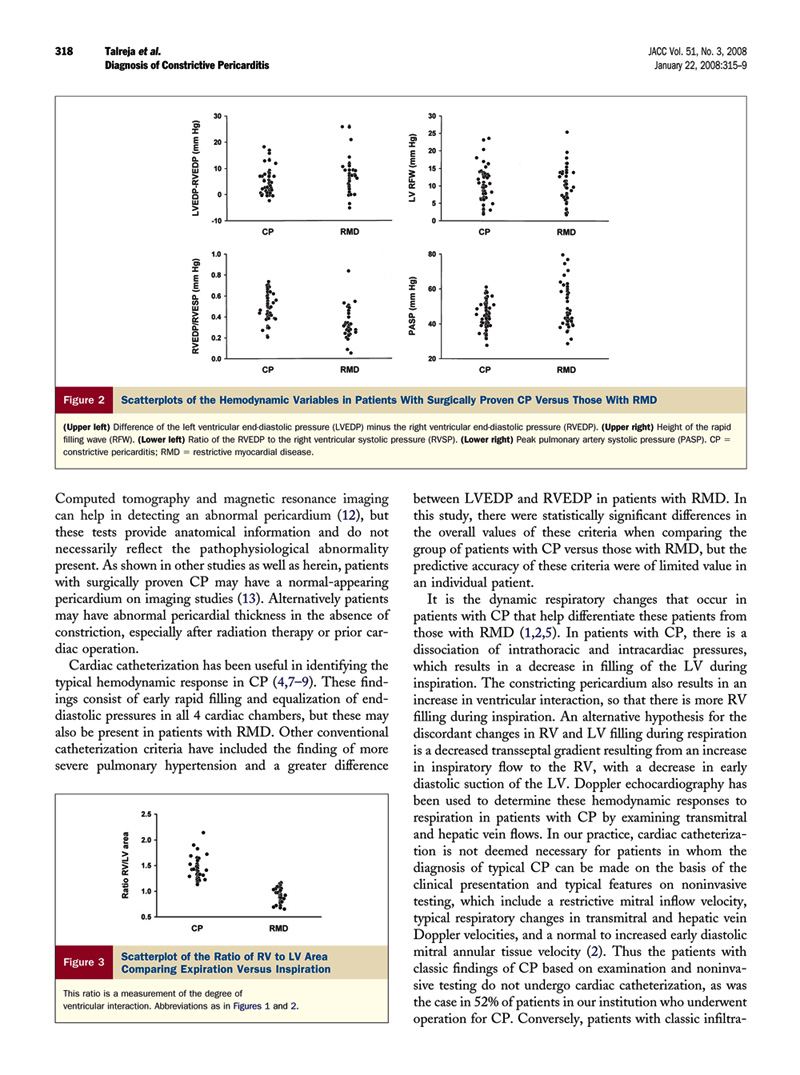
The intrapericardial space is obliterated
in constrictive pericarditis (fig.
38i and fig. 38j). As a result,
during inspiration, the decreased intrathoracic pressure is
not transmitted to the heart, venous pressure does not fall,
and systemic venous return fails to increase. As a result of
the faster than normal filling in constrictive pericarditis,
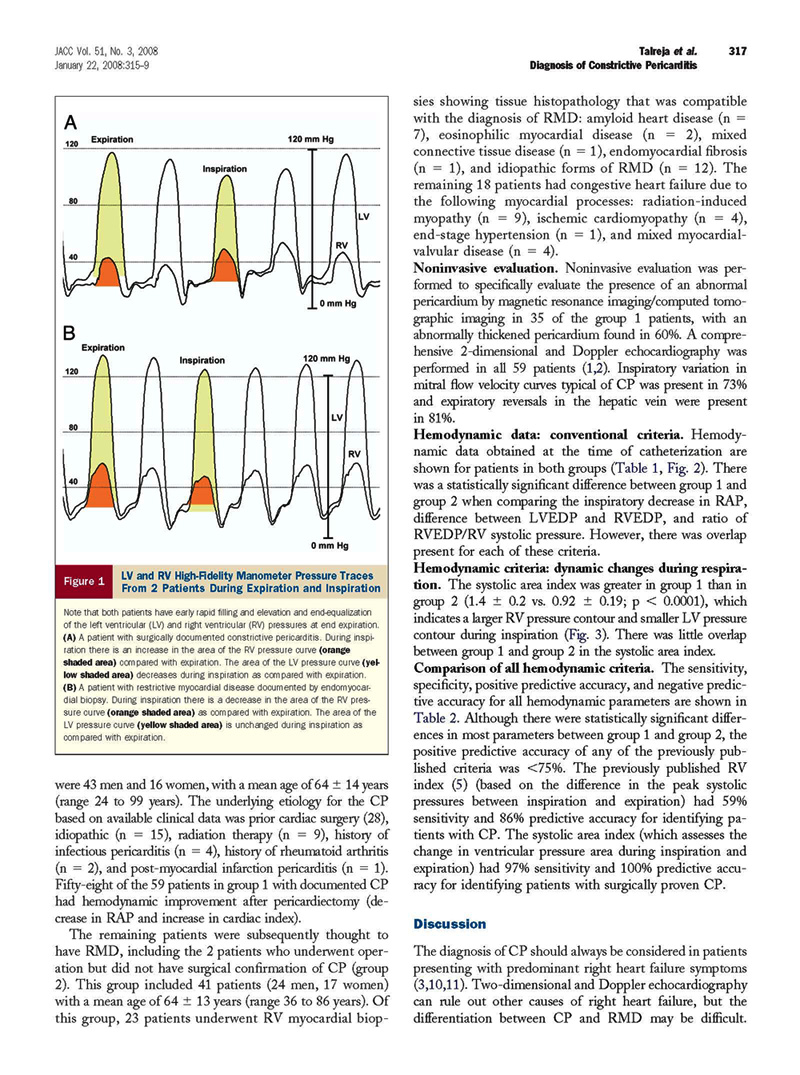
the ventricular diastolic pressure is characterized by a dip
in early diastole (fig. 38h). By
the end of the rapid filling phase, the ventricles are completely
filled and the ventricular diastolic pressure remains unchanged
and elevated for the remainder of diastole. The resultant pattern
of ventricular diastolic pressure in constrictive pericarditis
is referred to as the "dip-and-plateau pattern" or
the "square-root-sign"
Early diastolic filling in constrictive pericarditis
is unrestrained, and only at the end of the first third of diastole
does the stiff pericardium abruptly restrict ventricular filling.
As a result, ventricular pressure falls rapidly in early diastole
and subsequently rises abruptly to an elevated level, where
it remains until the next ventricular systole. End-diastolic
ventricular pressures and mean atrial pressures are elevated
and nearly equal (within 5 mmHg), and end-diastolic volumes
and consequently, stroke volume and cardiac output are reduced.
These pathophysiologic changes are responsible for the hemodynamic
and physical findings that characterize constrictive pericarditis.
Hoit,Brain D.,Diseases of the Pericardium,Hurst's
The Heart,10th edition,pages 2061-2085.
Abnormal Venous Pulse In Various Conditions Including Constrictive
Pericarditis
ELEVATED VENOUS PRESSURE
The most common cause of an elevated
jugular venous pressure is an increased RV pressure such as
occurs in patients with pulmonic stenosis, pulmonary hypertension,
or RV failure secondary to left-sided heart failure or RV infarction.
The venous pressure also is elevated when obstruction to RV
inflow occurs, as with tricuspid stenosis or RA myxoma, or when
constrictive pencardial disease impedes RV inflow. It also may
result from vena cava obstruction and, at times, an increased
blood volume. Patients with obstructive pulmonary disease may
have an elevated venous pressure only during expiration.
KUSSMAUL'S SIGN
Normally, during inspiration, there is
an increase in the a wave of the JVP but a decrease in the mean
jugular venous pressure as a result of the increased filling
of the right-sided chambers associated with the decrease in
intrathoracic pressure. Kussmaul's sign denotes an inspiratory
increase in the venous pressure, which may occur in patients
with severe constrictive pencarditis when the heart is unable
to accept the increase in RV volume without a marked increase
in the filling pressure. Although Kussmaul's sign was first
described in patients with constrictive pericarditis, its most
common cause is severe rightsided heart failure, regardless
of etiology. The presence of Kussmaul's sign is also useful
in the diagnosis of RV infarction.
ABNORMALITIES OF THE a WAVE
The a wave in the JVP is absent when
there is no effective atrial contraction, such as in atrial
fibrillation (see Fig. 38f-E).
In certain other conditions, the a wave may not be apparent.
In sinus tachycardia, the a wave may fuse with the preceding
v wave, particularly if the PR interval is prolonged. In some
patients with sinus tachycardia, the jugular a wave may occur
during the v or y descent and may be small or absent. In the
presence of first-degree AV block, a discrete a wave with ascending
and descending limbs is often completed prior to the first heart
sound, and the ac interval is prolonged (see Fig.
38f-F).
Large a waves are of considerable diagnostic value (see Fig.
38f-B). When giant a waves are present with each beat, the
right atrium is contracting against an increased resistance.
This may result from obstruction at the tricuspid valve (tricuspid
stenosis or atresia, right atrial myxoma) or conditions associated
with increased resistance to RV filling. A giant a wave is more
likely to occur in patients with pulmonic stenosis or pulmonary
hypertension in whom both the atrial and ventricular septa are
intact.
Cannon a waves occur when the right atrium contracts while the
tricuspid valve is closed during RV systole. 20° Cannon
a waves may occur either regularly or irregularly and are most
common in the presence of arrhythmias (see Fig.
38f-G).
ABNORMALITIES OF THE x WAVE
The most important alteration of the
normally negative systolic collapse (x wave) of the JVP is its
obliteration or even replacement by a positive wave. This is
usually due to tricuspid regurgitation. Although atrial relaxation
may contribute to the normal x descent, the development of atrial
fibrillation does not obliterate the x wave except in the presence
of tricuspid regurgitation. Accordingly, the occurrence of a
positive wave in the JVP during ventricular systole is strong
evidence of tricuspid regurgitation (Fig.
38f-A). Mild tricuspid regurgitation lessens and shortens
the downward x wave as the regurgitation of blood into the right
atrium produces a positive wave that diminishes the usual systolic
fall in venous pressure. In some patients with moderate tricuspid
regurgitation, there is a fairly distinct positive wave during
ventricular systole between the c and v waves. This abnormal
systolic waveform is usually referred to as a v or cv wave,
although it has also been referred to as an r (regurgitant)
or an s (systolic) wave. In patients with constrictive pericarditis,
the x descent wave during systole is often more prominent than
the early diastolic y wave (see Fig.
38f-C ).
ABNORMALITIES OF THE v WAVE
The positive, late systolic v wave results
from the increasing RA blood volume during ventricular systole
when the tricuspid valve normally is closed. With mild tricuspid
regurgitation, the v wave and the obliteration of the x descent
result in a single, large positive systolic wave (ventricularization)
(see Fig. 38f-A and fig.
38g).
Normally in the JVP the v wave is lower in amplitude than the
a wave. In patients with an ASD, however, the a and v waves
are often equal in the right atrium and the JVP (see Fig.
38f-D). In patients with constrictive pericarditis and sinus
rhythm, the RA a and v waves also may be equal, but the venous
pressure is increased, which is unusual with isolated ASD. In
patients with constrictive pericarditis who are in atnal fibrillation,
the cv wave is prominent and the y descent rapid.
ABNORMALITIES OF THE y TROUGH
The y descent, or diastolic collapse,
is produced mainly by the tricuspid valve opening and the rapid
inflow of blood into the right ventricle. A rapid, deep y descent
in early diastole occurs with severe tricuspid regurgitation
(see Fig. 38f-A). A venous pulse
characterized by a sharp y descent, a deep y trough, and a rapid
ascent to the baseline is seen in patients with constrictive
pericarditis or with severe right-sided heart failure. A slow
y descent in the JVP suggests an obstruction to RV filling and
may be the only abnormal finding in patients with tricuspid
stenosis or right atrial myxoma (see Fig.
38f-B). In both constrictive pericarditis and severe right-sided
heart failure, the venous pressure is elevated with a sharp
y dip in the JVP. The presence of a large positive systolic
venous wave favors the diagnosis of severe heart failure.
Effects of Arrhythmias on the Venous
Pulse
Large a waves in the JVP during arrhythmias
are present when the P wave (atrial contraction) occurs between
the onset of the QRS complex and the termination of the T wave
(see Fig. 38f-G). Such cannon a
waves may occur regularly in junctional rhythm. More commonly,
they occur irregularly when AV dissociation accompanies premature
ventricular beats, ventricular tachycardia, or complete heart
block. The a wave is absent in patients with atrial fibrillation,
and flutter a waves at a regular rate of 250 to 300 per minute
occasionally are observed in patients with atrial flutter and
varying degrees of AV block. Patients with multifocal atrial
tachycardia often have prominent and somewhat variable a waves
in the JVP. In these patients, many of whom have pulmonary hypertension
secondary to lung disease, the a wave are often very large.
Rourke,R.A. and others, The History,Physical
Examination,And Cardiac Auscultation ,Hurst's The Heart,10th
edition,pages 226-230.